


PCD, Solid CVD Crystal Diamond, and MCD: A Comprehensive Analysis and Comparison of Differences

Within the family of superhard materials, diamond has consistently held a central position due to its unparalleled hardness, excellent thermal conductivity, and exceptional wear resistance. With the continuous evolution of synthesis technologies, synthetic diamond materials have diversified into a wide array of products exhibiting distinct forms and characteristics. Among these, the most representative varieties are Polycrystalline Diamond (PCD), Solid CVD Crystal Diamond(Chemical Vapor Deposition Diamond with Polycrystalline), and Monocrystalline Diamond (MCD).
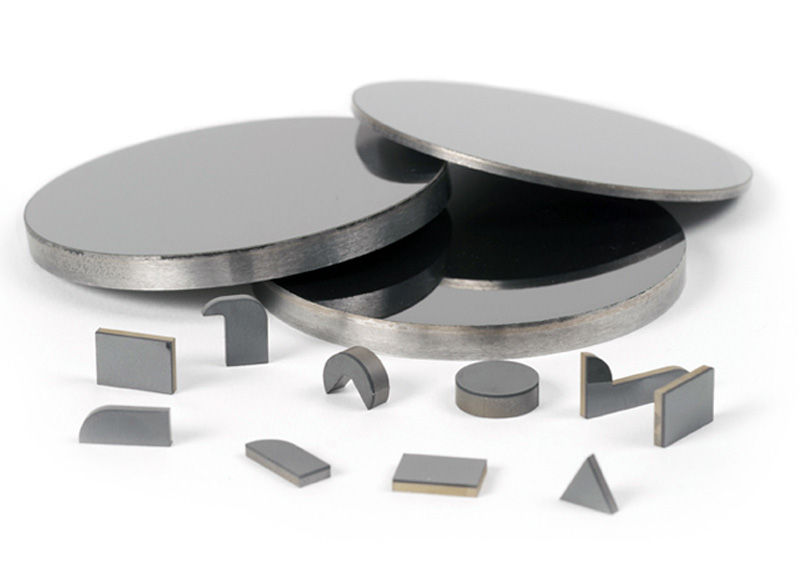
Polycrystalline Diamond (PCD) is a novel super-hard material that has been developed since the 1970s. It is produced by sintering natural or synthetic diamond micro-powders—combined with metallic binders such as cobalt or nickel—under conditions of high temperature (1000–2000°C) and high pressure (5–7 GPa) to form a composite sheet with a polycrystalline structure.
The polycrystalline structure of PCD endows it with a combination of high hardness, superior wear resistance, and excellent impact resistance. Its hardness can reach approximately 10,000 HV. Furthermore, due to the random orientation of its crystal grains and the absence of cleavage planes, it exhibits isotropic properties; consequently, it is less prone to brittle fracture, and its toughness surpasses that of single-crystal diamond. The PCD layer typically ranges in thickness from 0.3 to 1.0 mm and can be further cut, brazed, and ground to fabricate various types of cutting tools.
Leveraging its exceptional comprehensive performance, PCD is widely utilized in fields such as oil and gas extraction, coal and geological exploration, automotive manufacturing, and aerospace. It is particularly well-suited for heavy-duty rough machining operations and applications where high demands are placed on a tool's fracture toughness. PCD cutting tools typically appear black in color; this visual characteristic serves as a useful basis for preliminary identification.

Polycrystalline CVD Diamond also called Solid CVD Crystal Diamond, is synthesized using the Chemical Vapor Deposition method. This process involves mixing carbon-containing gases (such as methane) with hydrogen in a sub-atmospheric pressure environment; these gases are then activated and decomposed, causing active carbon atoms to deposit and grow interactively on a substrate surface, thereby forming a high-purity diamond film or thick film. Depending on the specific deposition conditions, the CVD method can be utilized to produce either polycrystalline diamond films or single-crystal diamond—however, this article focuses primarily on CVD polycrystalline diamond.
The most prominent characteristics of CVD polycrystalline diamond are its high purity and the absence of metallic binders. Consequently, it exhibits the inherent properties of diamond: exceptional hardness, high corrosion resistance, superior wear resistance, and excellent thermal conductivity. Furthermore, as there is no need to account for crystal orientation, its ease of use is significantly enhanced.
CVD diamond serves as an ideal material for the fabrication of optical windows, high-power electronic devices, heat-dissipation coatings, and precision machining tools. In cutting tool applications, CVD diamond is particularly well-suited for finishing and semi-finishing operations, enabling the achievement of superior surface finishes.

Monocrystalline Diamond (MCD) is a synthetic single-crystal diamond produced via the High-Pressure High-Temperature (HPHT) method. This process involves reacting graphite powder with transition metal catalysts under extremely high temperatures and pressures to grow single-crystal particles possessing a complete crystalline structure. The resulting MCD typically exhibits a pale yellow hue and features well-defined octahedral or rhombic dodecahedral crystal habits.
MCD possesses a microstructure and mechanical properties nearly identical to those of natural diamond, boasting a hardness of up to approximately 9000 kgf/mm². Furthermore, thanks to its single-crystal structure, it enables the creation of perfectly sharp cutting edges, allowing for machined surface roughness levels as low as Rz < 0.02 μm. However, monocrystalline diamond features four distinct cleavage planes; this inherent crystal anisotropy results in relatively low toughness and a high degree of brittleness. Its thermal-chemical stability limit is approximately 650°C; exceeding this temperature causes a significant degradation in performance.
MCD is an indispensable material in the field of ultra-precision machining. It is widely utilized in the processing of optical lenses, medical devices, 3C electronics, and precision aerospace components, enabling the achievement of mirror-finish surface quality. MCD tool inserts are typically available in dimensions reaching approximately 8 mm × 8 mm × 1.6 mm.
IV. Comparison of the Three Types of Diamond
4.1 Synthesis Methods
The most significant difference among the three lies in their synthesis processes. Both PCD and MCD are produced under high-temperature, high-pressure (HPHT) conditions, whereas CVD polycrystalline diamond is grown through deposition in a low-pressure gaseous environment.
Comparison | PCD | Solid CVD Crystal Diamond | MCD |
Synthesis Method | HPHT Sintering | Chemical Vapor Deposition | HPHT Growing |
Synthesis Pressure | 5~7 Gpa | <0.1 Mpa | 5~6 Gpa |
Synthesis Temperature | 1000~2000℃ | 700~1000℃ | 1300~1700℃ |
PCD features a short synthesis cycle and controllable costs, making it the first synthetic diamond material to achieve large-scale industrial production; the CVD method enables the fabrication of large-sized, high-purity diamond polycrystalline, though their growth cycle is relatively long; conversely, the single-crystal growth process for MCD imposes extremely stringent requirements on process control, resulting in the highest production costs.
4.2 Microstructure and Crystal Morphology
Differences in microstructure are key to understanding the distinct performance characteristics of these three classes of materials.
MCD: A single, large crystal on a macroscopic scale, possessing a complete crystal lattice structure and four cleavage planes. Its anisotropic nature implies significant variations in mechanical properties depending on the direction; therefore, when utilized, the optimal cleavage plane must be selected to serve as the cutting face.
PCD: A polycrystalline composite formed by the disordered arrangement of numerous micron-sized diamond grains bound together by a binder phase. With randomly oriented grains and an absence of cleavage planes, it exhibits isotropic behavior, meaning that crystal orientation need not be taken into account during application.
CVD Polycrystalline Diamond: A highly dense polycrystalline film composed of diamond grains ranging from the nanoscale to the micron scale. It features no internal grain boundary voids and demonstrates exceptional structural uniformity. Unlike PCD, CVD polycrystalline diamond contains no metallic binder and constitutes a material of 100% pure diamond.
Typically, the grain size in PCD is the largest among the three, whereas the grains in CVD polycrystalline diamond are significantly finer and more densely packed.
4.3 Performance Comparison
Comparison | PCD | Solid CVD Crystal Diamond | MCD |
Hardness | approx. 10000 HV | Extremely High (approx. 2.5 times the PCD) | approx.9000 kgf/mm² |
Toughness | High (Superior to monocrystalline) | High | Low (relatively high brittleness) |
Thermal Stability | Medium (Contains Binder) | High (Binder-free) | Medium (approx. 650°C) |
Anisotropy | Isotropy | Nearly isotropic | Anisotropy (with cleavage planes) |
Wear Resistance | Excellent | Excellent | Good |
Thermal Conductivity | High | Extremely high | High |
In terms of hardness, CVD polycrystalline diamond exhibits the highest hardness, exceeding that of PCD by more than 2.5 times. Due to the presence of a metallic binder, PCD’s hardness is slightly lower than that of pure diamond materials; however, it possesses a distinct advantage in toughness and demonstrates superior impact resistance. Although MCD boasts extremely high hardness and allows for the creation of a perfect cutting edge, the presence of cleavage planes renders it relatively brittle, making it more susceptible to fracture under impact loads.
Regarding thermal stability, CVD polycrystalline diamond contains no metallic binders or residual catalysts, thereby offering optimal thermal stability. The presence of binders in PCD results in slightly inferior chemical stability at high temperatures, while the performance of MCD begins to degrade at temperatures exceeding approximately 650°C.
4.4 Processing and Application Fields
Each of the three material types occupies a distinct niche within machining applications, with specific areas of focus.
PCD: Best suited for rough machining and applications requiring high fracture toughness—such as the processing of high-silicon aluminum alloys, metal matrix composites (MMCs), carbon fiber reinforced plastics (CFRPs), and graphite. Thanks to their excellent wear resistance and impact strength, PCD tools hold a prominent position in fields such as drilling, mining, and the rough machining of automotive components.
CVD Polycrystalline Diamond: Excels in finishing, semi-finishing, and continuous turning operations, enabling the achievement of superior surface finishes,espeically for for workpieces with significant tool wear. When milling lightweight materials such as CFRP, the tool life of CVD-D cutters can be up to four times that of PCD tools. Furthermore, CVD diamond is widely utilized in high-end sectors such as optical windows, laser devices, electronic packaging, and thermal management.
MCD: Primarily targets the field of ultra-precision machining. Single-crystal diamond can be ground to produce extremely sharp cutting edges, capable of achieving surface roughness levels equivalent to a mirror finish (Ra < 0.025 μm). Consequently, it serves as the ideal machining tool for workpieces demanding exceptionally high surface quality—such as optical lenses, medical surgical instruments, and precision molds.
It is worth noting that none of these three material types are recommended for machining ferrous metals (such as steel or cast iron). Diamond undergoes a chemical reaction with iron at high temperatures, leading to rapid tool wear; therefore, diamond tools are predominantly employed in the machining of non-ferrous metals and non-metallic materials.
4.5 Visual Identification
The visual appearance of these three types of materials can serve as a reference for preliminary identification: MCD generally exhibits a pale yellow hue, so normally called "yellow diamond"; CVD single-crystal diamond can range from colorless and transparent to various colors, so normally called "white diamond"; and PCD are universally black.
V.Summary
Depending on the manufacturing method, diamonds can be classified into the following categories:

PCD, CVD polycrystalline diamond, and MCD all belong to the family of synthetic diamonds; however, each possesses distinct characteristics regarding microstructure, mechanical properties, and applicable scenarios. Thanks to its exceptional impact toughness and cost-effectiveness, PCD serves as a mainstay in the fields of industrial rough machining and drilling. CVD polycrystalline diamond—characterized by its binder-free, high-purity composition and superior surface finish—occupies a unique niche in precision machining and high-end functional device applications. MCD, with its perfect single-crystal structure closely resembling that of natural diamond, remains irreplaceable in the realm of ultra-precision mirror-finish machining. In practical application, the relationship among these three materials is not merely a matter of relative superiority or inferiority; rather, depending on specific working conditions, they leverage their respective strengths and complement one another, collectively underpinning the vast landscape of modern ultra-hard material processing technology.

Comments