


WhatsApp/Wechat: +86 185 100 35738


PCD Inserts: Tipped and Laminated Designs for Demanding Materials
PCD inserts are polycrystalline diamond cutting inserts designed for high wear resistance, long tool life, and excellent surface finish in non-ferrous and composite machining. ToolingBox supplies ISO-standard PCD inserts in tipped and laminated designs, with multiple PCD grades and custom options for specific workpiece materials and applications.
What Are PCD Inserts?
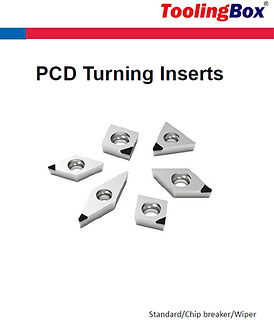
PCD inserts consist of a polycrystalline diamond layer sintered onto a tungsten carbide substrate. The diamond layer provides extreme hardness and abrasion resistance, while the carbide substrate provides toughness and supports clamping or brazing. This combination allows PCD inserts to maintain a sharp cutting edge in abrasive materials where carbide inserts wear quickly.
PCD inserts are commonly used for aluminum and aluminum alloys, copper, brass, bronze, zinc, magnesium, CFRP, GFRP, graphite composites, plastics, and other abrasive non-ferrous materials. They are generally not recommended for ferrous materials unless the process is specifically evaluated; in many iron-based applications, CBN inserts are the more suitable solution.
ToolingBox PCD Insert Grades & Workpiece Matching:
ToolingBox offers multiple PCD grades to match different workpiece materials, surface finish requirements, and wear conditions. Final grade selection depends on the specific application, including workpiece abrasiveness, machine stability, edge preparation, and target surface quality.
For assistance in matching a PCD grade to your workpiece material and machining process, contact the ToolingBox engineering team via sales@toolingbox.com with your application details.
Tipped PCD vs. Laminated PCD Inserts:
ToolingBox offers two main PCD insert designs: tipped PCD and laminated PCD. The right choice depends on where the cutting action occurs, how much of the edge is engaged, and the required tool life.
Main Sharps for tipped PCD inserts (figure 1):
Tipped PCD inserts have a diamond tip brazed at the cutting corner. This design is suitable for applications where the cutting action is concentrated at the corner and a sharp, defined edge geometry is required. Tipped PCD inserts are often used for turning, facing, and boring operations where the corner performs the main cutting work.

Main Sharps for Laminated PCD insert (figure 2):
Laminated PCD inserts have a diamond layer covering the entire top surface. This design provides a longer wear path when the full cutting edge participates in the operation. Laminated PCD inserts are often selected for applications requiring extended tool life and greater resistance to abrasive wear along the edge.


Applications by Workpiece Material:
PCD inserts are selected across a wide range of non-ferrous and composite materials. Typical applications include:
-
Aluminum and aluminum alloys — PCD inserts provide wear resistance and edge retention, including in high-silicon aluminum applications. For very high silicon content or specific finishing requirements, ToolingBox can advise on the most suitable diamond grade.
-
Copper, brass, and bronze — PCD inserts help maintain a sharp edge and consistent surface finish while reducing built-up edge in many operations.
-
Zinc and magnesium alloys — PCD tooling supports high-speed machining and long tool life in non-ferrous components.
-
CFRP, GFRP, and composite materials — With suitable geometry and grade selection, PCD inserts help reduce fiber pull-out and delamination while improving edge quality.
-
Graphite and graphite composites — PCD inserts offer good wear resistance and edge retention in abrasive graphite machining.
-
Plastics and acrylic — Sharp PCD edges help produce clean cuts and good surface finish.
-
Metal matrix composites (MMC) — Abrasive MMC materials benefit from PCD grades selected for high wear resistance.
ToolingBox ISO Sizes & Specifications for PCD inserts
ToolingBox PCD turning inserts are available in common ISO standard shapes and sizes. Standard and application-specific configurations can be reviewed based on insert shape, clearance angle, tolerance, chipbreaker, PCD type, and grade.
ToolingBox can produce special PCD inserts according to customer requirements. Custom options include non-standard geometries, corner radii, edge preparation, chipbreaker configurations, PCD grade selection, and tipped or laminated PCD designs.
To evaluate a custom PCD insert, please provide the workpiece material, machining operation, required dimensions, tolerance, surface finish target, and a drawing if available. The ToolingBox engineering team will review the application and recommend a suitable PCD insert solution.
All ToolingBox PCD inserts are manufactured under an ISO 9001 quality management system.
FAQ:
What is the difference between tipped and laminated PCD inserts?
Tipped PCD inserts have a diamond tip at the cutting corner, while laminated PCD inserts have a diamond layer covering the entire top surface. Tipped designs are often used when cutting is concentrated at the corner; laminated designs are often selected when the full edge is engaged and longer wear life is required.
Can PCD inserts machine ferrous materials?
PCD inserts are generally not recommended for ferrous materials unless the process is specifically evaluated. In many iron-based applications, CBN inserts are the more suitable option.
Which PCD grade should I choose?
Grade selection depends on workpiece abrasiveness, required surface finish, edge toughness, and machining conditions. Fine-grain PCD is often used for finishing and sharp-edge applications; medium-grain PCD offers a balance of wear resistance and toughness; coarse-grain PCD is used for highly abrasive conditions.
Does ToolingBox offer custom PCD inserts?
Yes. ToolingBox can produce special PCD inserts according to customer drawings and application requirements, including non-standard geometries, edge preparation, and PCD grade selection.
Are ISO standard PCD insert sizes available?
Yes. ToolingBox offers PCD turning inserts in common ISO standard shapes and sizes. Please refer to the online store for the current size list or contact ToolingBox with your specific requirements.
NOTE: If you are interested, you can visit our online store ,or Get a Quote for B2B inquiry.
